


Welcome to Red Birds Trust
Local Advocates Preserving and Protecting the Onaqui Wild Horses of Utah


R
ed Birds Trust 501(c)(3) is a grass roots organization based in Tooele, Utah founded by wild horse advocates who live locally and who have immersed themselves in the daily lives of the Onaqui in Utah's west desert.
It is our goal to help these wild horses live their best lives both on the range and after adoption. Because all board positions are filled by volunteers donating their time and energy to the cause it then allows for 100% of all donations to go to the betterment of our wild and adopted Onaqui horses.
You can read more about each of the horses we've helped to rescue by clicking here.
Nearly every single month of 2024 through 2026 another Onaqui has surfaced who needs help and Red Birds Trust has endless gratitude for the network of supporters, rescuers and home placements who have stepped up to help RBT continue to be there for our beloved Onaqui. The monthly accounts of all the horses helped is detailed here on our Year End Recap page.
A direct link to the BLM's 2021 informational page on the Onaqui Roundup which includes number of horses removed can be found on the BLM website at: https://www.blm.gov/programs/whb/utah/2021-onaqui-wild-horse

Onaqui Wild Horse Viewing & Safety
With that tolerance unfortunately brings out the Bison Petters and with that leads to harassment, feeding/petting, drones, range degradation and even beloved horses being shot and killed. All of this behavior is against federal law.
Utah just came out of the driest winter on record and numerous articles have been published regarding concern for local crops, the health of the Great Salt Lake and pending severe drought conditions. That also means a great impact on the Onaqui Herd Management Area.
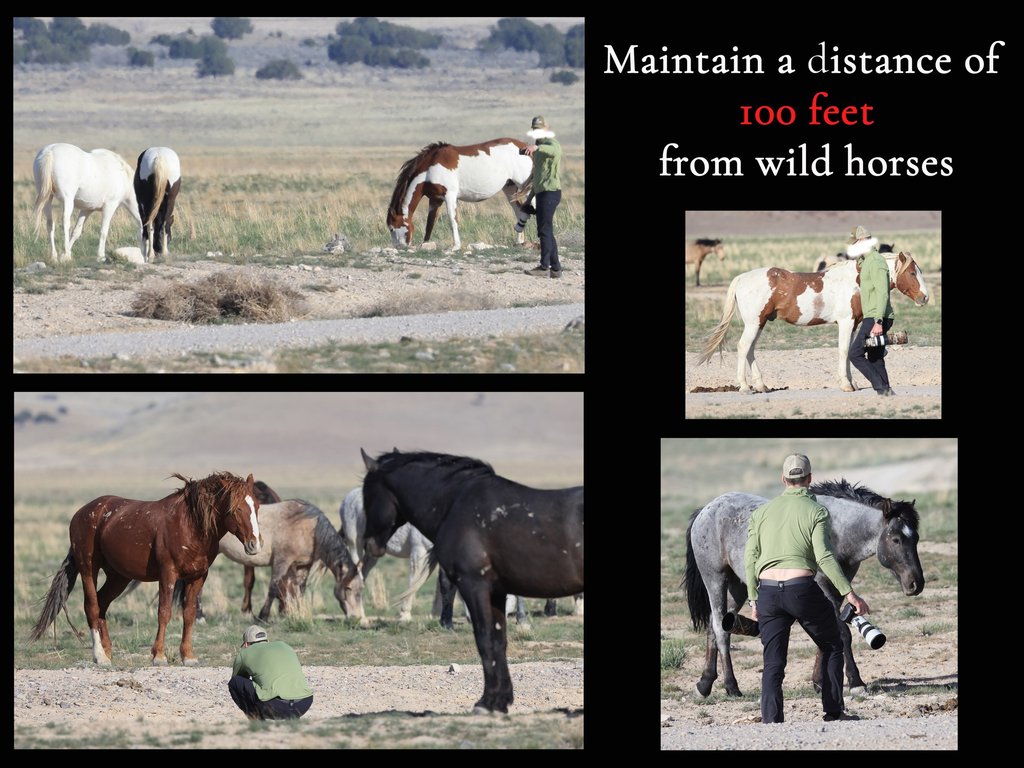
Already new tire tracks are lacing the cracked soil, driving over precious grass which is barely there to begin with. Recently a photographer carrying 2 cameras and a cell phone was witness running through the herd, approaching within 10 feet to take selfies, squatting between stallions to get "the shot" without any attempt whatsoever to give the herd the 100 foot minimum distance requirement. He even ran past a small family with an injured 3 week old filly who was sleeping, trying to rest her swollen back leg; completely oblivious. Numerous photos and videos have shown up on social media of photographers standing inside watering holes again to get "that" water shot, with little or no consideration to the stress the herds, especially in the south, are already under with a lack of resources currently available.
Although it may seem like the Wild West out there, rules, regulations and legal requirements are in place. Some of the most critical include:
1) Maintaining 100 foot distance from the herd. If they approach you, take the path of least resistance and least disturbance to back away to 100 feet, or to your vehicle.
2) Maintaining 200 foot distance at watering holes and from new foals. Watering holes are already areas where the horses experience stress with so many trying to get water from a small area and the horses are on edge without us contributing to that or preventing them from watering. New foals are also susceptible to harm and the bands are increasingly protective of the little ones often causing fights over space and boundaries - give them the space they need to stay safe and work it out.
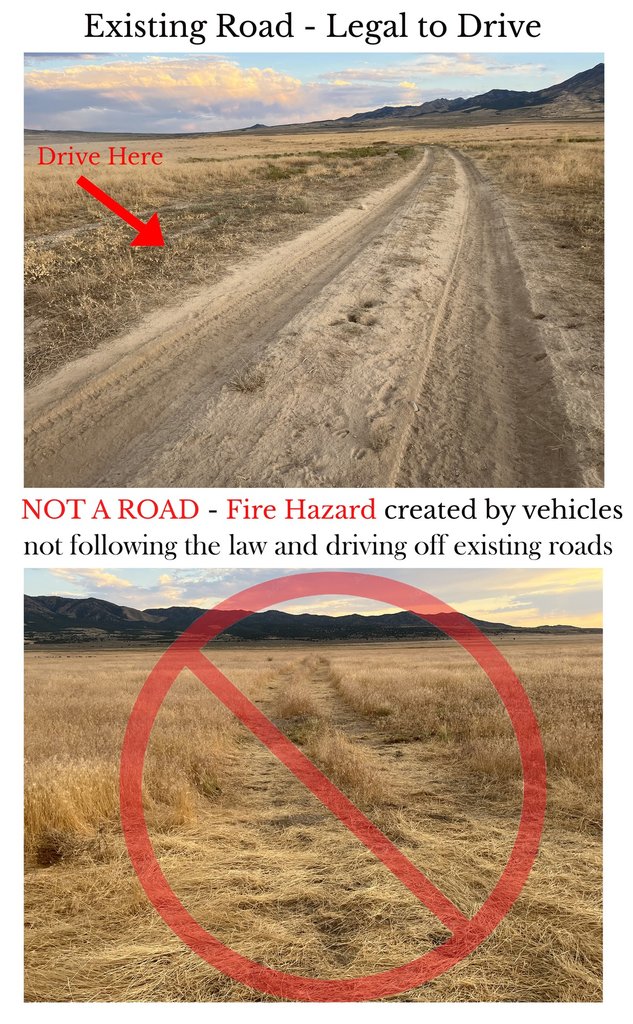
3) Travel by motorized vehicle is prohibited off established roadways. This means DO NOT drive off road. Seeing tire tracks where someone else destroyed precious habitat doesn't mean it's legal or right. Established roadways are obvious and they aren't someone else's tire tracks. Most of the established roads will show up on your cars navigation map. If you are in doubt that is a good resource to use.
4) Drones are not permitted. This is a closed air space and drones are illegal. Because they sound like helicopters, they also terrorize the horses. Unfortunately, several have already suffered injuries, even leading to death, after the launching of drones by photographers.
If you observe people driving off-road, entering watering holes or blocking the horses access to watering holes, petting or feeding the wild horses, chasing them with vehicles or dogs, launching drones or other flagrant behavior please take the following steps to document and report it.
Steps To File A Report:
1) In an emergency call 911 or Tooele County Sheriff?s Office (435) 882-5600
2) For a severely injured horse call or text the Range Specialist (801) 419-4552
3) To File A Report:
- Capture photos and video of the behavior, the vehicle and the license plate. Cell phone photos are helpful to be able to access the GPS coordinates off the photo later.
- Email a summary of your observations including the location, time and date. GPS coordinates of the incident can be pulled off of an iphone photo to be included in your report.
- Remove any apples, carrots or other food left on the range.
- If a drone is launched, video the drone, the operator and the herd.
- Email your documentation to: thowell@blm.gov and BLM_UT_WHB@blm.gov
This is going to be a hard year for the Onaqui, and other wild herds across the west and we hope people will do better and give them the space they need to stay wild while still enjoying all they have to teach us.
Onaqui Herd Management Area Clean-ups
The Onaqui HMA is located 40 miles southwest of Tooele and covers an impressive 240,153 acres of public and state lands accessed by the historic Pony Express Byway. There are two main bands of Onaqui horses, one in the north and one in the south. When traversing the range on foot it is all too common to come across old barbed wire fences, downed posts, litter and other human waste that can be very dangerous to the horses well-being.
Red Birds Trust has conducted nemerous range cleanups with the help of our local BLM field office and countless volunteers who have traveled to Utah from 13 different states and even several international destinations. We've been able to remove 15+ miles of old, dangerous fencing to date and look forward to removing more. Maintaining a volunteer database makes our clean-up efforts seamless and we are excited to have a strong team locally and beyond who are committed to offering their valuable time for the betterment of the wild horses.
2027 Range Cleanup Dates TBA in early 2027

Onaqui Education
This organization is passionate about providing accurate information, educational resources, and updates of current events as they relate to the Onaqui horses and Herd Management Area (HMA) they call home. We look forward to sharing information and garnering support for these cherished wild mustangs.
Onaqui Rescues & Assistance
All 303 Onaqui horses put up for adoption at the Delta Utah BLM facility in December 2021 were adopted into private homes, sanctuaries and/or by TIP trainers. We are forever grateful for everyone who came through to make this happen by opening their hearts and homes, offering donations and advocating for the best placements for individual horses.
Caring for a horse is a huge commitment on many levels. One that takes time, patience, love and financial committment. Donations received will be allocated for: providing safe transporation of Onaqui horses rescued from kill pens or at-risk situations, training resources, medical care and other unforseen emergency situations for adopted Onaqui horses including Onaqui adopted by members of this organization.
Red Birds Trust wants to offer a community based approach for care and resources for these special horses and be able to allocate donations to those in need of temporary assistance with their Onaqui due to unforseen circumstances or financial hardship. By building a community who can help each other through the difficult times and celebrate the good we can only hope that it will also help keep them in their forever homes rather than ending up abandoned, in poor health or in kill pens.
A direct link to the BLM's 2021 informational page on the Onaqui Roundup which includes number of horses removed, application for adoption, and adoption requirements can be found at: https://www.blm.gov/programs/whb/utah/2021-onaqui-wild-horse

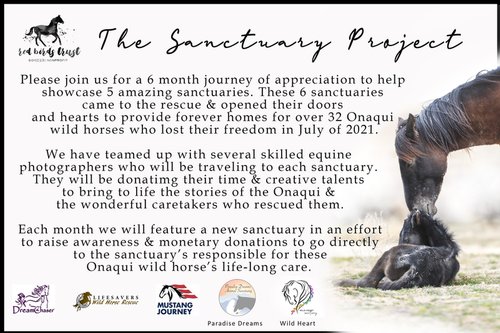
Please visit our FaceBook page for a 6 month special project (July 2022 to November 2022) where equine photographers and sanctuaries came together to share their stories of Onaqui rounded up in 2021 that now call these sanctuaries home. Each month a new sanctuary was featured with stories and images of their mission, vision, background and current needs.
Current images of our Onaqui in their new homes will depict their current lives and give suggestions for how you can help them succeed in the future.

 Facebook
 Twitter
 LinkedIn
 Pinterest
 Tumblr
 StumbleUpon
 Reddit
 Email
Email Loading...